Into the Dark Backward
His brother’s writing became one of the longest comics ever.
It begins the universe.
The page is covered in the inky black of a magic marker and six words written in Wite-Out: IN THE BEGINNING, THERE WAS DARKNESS. An addendum follows a page later: “It got boring real quick.” At which point a light bursts forth, and we’re transported to a hospital bed in Tokyo where a man is dying, and the story begins.
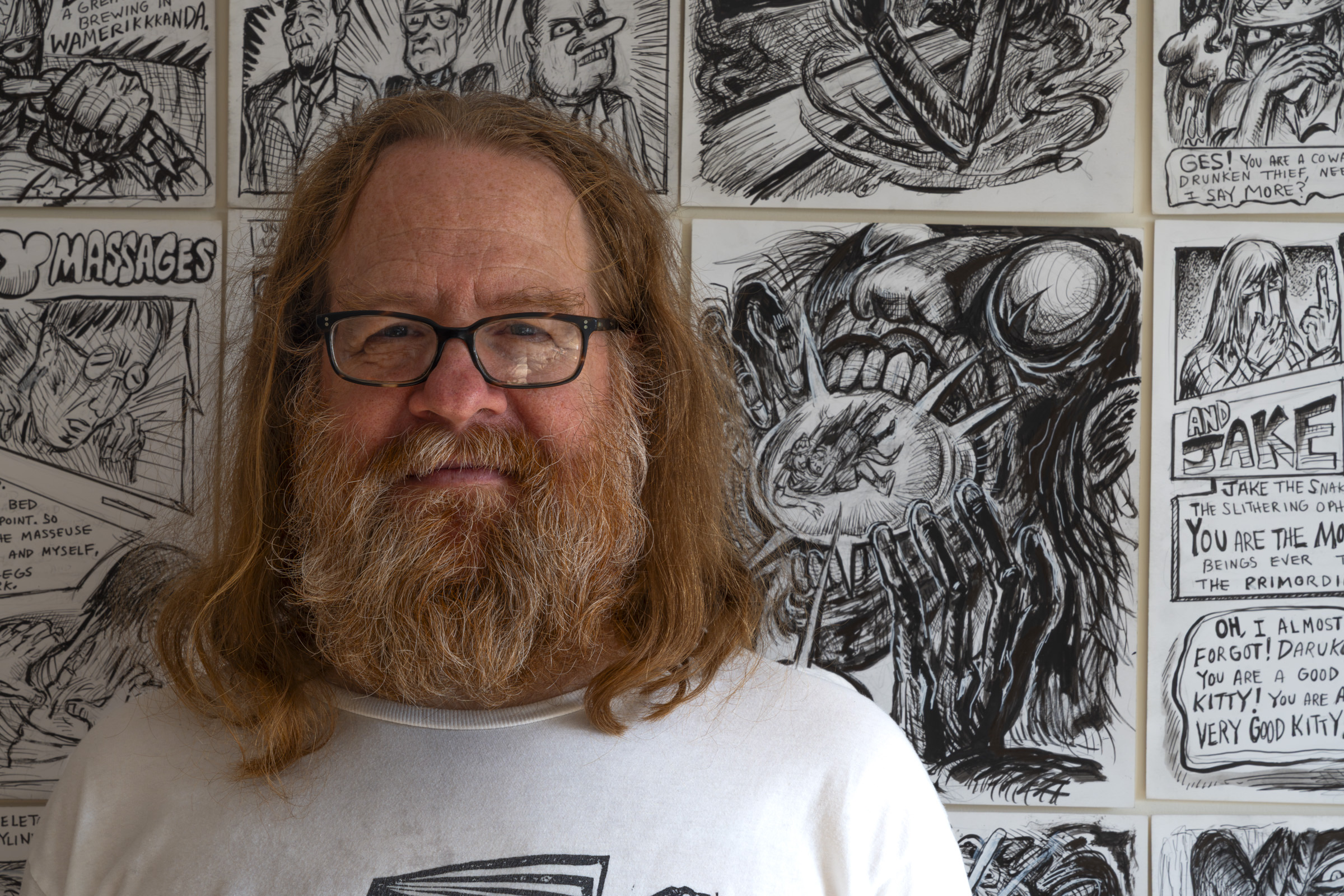
Today, the hand-drawn pages are laid out on Mark Stilwell’s dining room in Flat bush, Brooklyn. Mark has the look of an eccentric artist. A spry 56, with long straw berry-brown hair tied into a ponytail and a shaggy beard only now beginning to show traces of gray, he is dressed this afternoon in paint-flaked cargo shorts and a t-shirt emblazoned with a blacklight drawing byJack Kirby, the artist behind Marvel’s Silver Surfer and The Mighty Thor), alongside the quote, “Whatever I do…I can assure you that it’ll electrocute you in the mind!”
Mark’s apartment matches the aesthetic. Past a Japanese curtain in the entry, the living room is a farrago of artistic and musical odds and ends: a record collection and stereo, a Squire Stratocaster on guitar stand, stacked file folders labeled with the names of art projects past. Looming in the corner is a sculptural piece of undefinable nature, four feet tall and made up of discarded cardboard, plastic wrap, shredded paper, duct tape, and the assorted debris of a Brooklyn street corner. It is, Mark explains, a remnant of a recent performance piece from one of the occasional robotand-monster-themed shows that he stages along with his students and fellow artists.
There are piles of notebooks here and there filled with drawings Mark made long ago. One of them is filled with comic book panels of robots and Godzillas locked in combat. “Luke and I used to do a lot of those,” Mark says. Luke is Mark’s older brother by two years. There are pictures of him scattered around the apartment if you know where to look; his dark hair and Delphic smile a somber contrast to Mark’s sandy mop and buoyant grin.
The centerpiece of the apartment, though, are the pages of Mark’s magnum opus, laid out today on the table in tall stacks for examination. “There it is,” Mark says, gesturing toward the piles somewhat abashedly. “Have at it.” Then he retreats to his small drawing table at the window to await the critical verdict.
Each page in these stacks belongs to an unpublished comic book, The Dark creation of the with Backwards. At just shy of 2,800 pages, it is among the longest comic books ever written, each page meticulously inked by hand.. Laid end to end, Stilwell’s comic pages extend about 30,701 inches; just shy of half a mile. You could cover the central span of the Brooklyn Bridge with them if you were so inclined, or just about make it across the grass of Prospect Park from this room in Flatbush. But the alarming fact to Stilwell himself is that it might not even be done: the page count even now is continuing to grow. He is on course, he says, to finish the book by the time the next school year starts, around Labor Day in September, 2026. He has been drawing it almost every day for the past 3,957 days.
It is difficult to summarize The Dark Backwards. Even now, Mark struggles with it, and he’s had longer to practice than almost anyone. Much of it follows the story of Kenji, an everyman among a race of immortals, who must contend with an ironically terminal medical diag nosis. To restore his life, Kenji is forced to assemble a band of companions, or nakama, in the manner of a ‘90s shonen manga comic.
But that doesn’t explain this comic; not really. The real story of The Dark Back wards is written in the opening pages, when the creation of the universe is sud denly interrupted by the plain, unbroken text of an email:
This is really hard to write and I’m writing to you because you’re my parents and you come first…
The writer is Luke Stilwell. The email continues:
I have terrible news. I have cancer.
Rectal cancer that has metastasized to the liver. Stage four. They can’t remove it, it’s onlychemo now and the prognosis is not good. My life expectancy is now maybe 1 to 3 years, 3 to 5 if the chemo works. Of course this is life expectancy.
Humans have what somewhere around 80, some die at fifteen some live to be a hundred and twenty. Nothing is fixed. We can think the worst or the best. I don’t know what to think about that except that I want to live as long as I can, and I’m going to try and beat this.
Luke sends this email to Mark Stilwell on May 15, 2015. That fall Mark gets on a plane from New York City to Tokyo, to the hospital bed of a brother he’d barely seen in 20 years. Months later, on Halloween night back in his birthplace of California, Luke will die. But before he does, he will tell Mark a story about the secret of the universe and its salvation, a story he’s been racing death to finish.
Before The Dark Backwards was Mark’s, it belonged to Luke. He began writing it as a novel sometime in the mid 1990s, and for two decades, completing it became the great mission of his life.
Sometimes a projection; sometimes an escape; sometimes abandoned; some times an object of almost manic focus.
The Dark Backwards became for Luke a looming and inescapable presence — an expanding world in which he somehow knew he could live forever.
At first, after his diagnosis, Luke wrote it himself, typing hectically from his bedroom, and then from his hospital bed; rushing to put words on the page like transcriptions from a rapid-fire telegram.
Then, when the labor of writing became too much, he recited it to his brother, who duly took down notes and promised to carry it on. When Mark returns home, he will take out a sheet of blank white computer paper and a Ticonderoga #2 pencil, and he will begin to draw it, one page at a time.
For the last 11 years, Mark has made the work of transcribing and interpreting this story the mission of his life, too. And still, he has not brought it to an end.
“[Luke] told me, ‘This is your story now, do with it what you will.’ ” Mark says.
“So I had to turn it into a massive epic.
I’m there at the beginning of the book, and then I have to be there at the end to tell the story. The death story.” ven when he was a kid, Mark Stilwell was thinking about Edeath. When he was around three years old, Mark’s father Carl found him playing with a set of G.I. Joe toys. “I noticed all the girls play with Barbie dolls and you play with G.I. Joes. Why don’t you have G.I. Joe date Barbie?” Carl asked him. “G.I. Joes don’t date Barbies,” Mark replied. “They kill them.”
The children of two teachers, Mark and his older brother Luke grew up in Pasadena, in LA’s San Fernando Valley, a hilly enclave that’s long been a home to artists and bohemians seeking to escape the urban grind of Los Angeles proper.
From the start, the boys were like mirror images. “He was the calmer one, I was the fiery one,” Mark remembers. “I looked up to him, loved him dearly, adored him. But I had a savage temper.”
“As a baby, [Mark] was really relaxed, and sweet, and gentle,” says Cheryl, the boys’ mother. “And then as a little boy, he had these horrible temper tantrums. He would throw things and break things.”
Luke was a different sort of kid. “Luke was special,” Cheryl says. “He was shyer than Mark, but he was very bright…He wanted to write a book, a great big book.
That was his aim in life. From the time he was a little kid, he wanted to write.”
Luke spent much of his youth buried in fantasy novels and Robotech cartoons.
He was a nerd, in an era when nerd cul ture was far from the mainstream. Luke did manage to form a small but devoted clique, including childhood friends Eric Smith and Tommy Alva, and his younger brother, Mark — a set of outcasts talking anime at the lunch table. “We were iso lated more by the popular people,” Eric explains. “Back in the ‘70s, kids either played ‘cowboys and Indians’ or ‘astro nauts and aliens.’ We played ‘astronauts and aliens.’”
“The Dark Backward” pag es hung on the wall of Mark’s apartment.
Mark had an easier time getting atten tion on the schoolyard. “Mark was just very much the opposite of Luke,” Eric says. “He was very outgoing and very rambunctious.” He still lost his temper.
He could snap and get violent at the drop of a dime. But it never stopped him from making friends, and by middle school Mark had begun to settle down, often riding bikes around the neighborhood with the other kids while Luke sat inside, buried in his books.
Despite their differences, the brothers came together over their love for stories in particular, comic books. They made a good match: while Luke was monoma niacally devoted to writing, Mark was a natural artist. In middle school and high school, they began making comics of their own. Mark still has some of their efforts from those years, battle-worn composi tion books filled with pastiches from Dr.
Who, Zeta Gundam, and MAD Magazine, like kaleidoscopes of ‘80s and ‘90s fan dom. “ “That was kind of our first form of collaboration” Mark says.
In 1996, Mark graduated from high school and went east to study art at the Pratt Institute in Brooklyn. Luke had graduated a couple of years earlier and decided to stay at home while taking classes at Pasadena City College. He made friends, but never dated, and even in freeway-crazy LA he never did learn to drive a car. His friends all thought he was brilliant, but there was a sense, even if no one would say it, that he was never quite sufficient on his own.With Mark now far away, Luke’s world turned increasingly inward, toward an imagined realm of kaiju and samurai.
One afternoon when he was 19, Luke and his friend Tommy were walking to an ice skating rink when an errant driver barrelled through a red light. Minutes later, Tommy was sitting beside Luke in an ambulance. “The break was such a clean break that his leg was like a sock,”
Tommy says.
After that a change seemed to come over Luke. He was angry, aggressive in a way he had never been before. He began insisting that he had “earned” a trip to Japan when he was mobile again.. He wanted to live there while there was still time. To Tommy, it seemed like the acci dent had rattled his friend. . “He never really recovered,” Tommy says. “I think this was a knockdown from [feeling invincible]. You know that you’re vul nerable.”
What Tommy didn’t know was that Luke had a secret. Some years earlier, his mother Cheryl had accidentally struck and killed a young boy with her car. Years later, on his deathbed, Luke would con fess that on the same day, he had also narrowly avoided being hit by a car while crossing the street. Fate had spared him then; now, it seemed, the cosmic scales were trying to balance..
Still, it was clear that time was of the essence. He began to write. very month, Mark Stilwell’s art club meets underneath the esca Elator in the food court at City Point in Brooklyn. Today Mark arrives first, spreading out his paper and art pens deliberately on the table. He’s joined a few minutes later by Mark Gonzales, looking cool with his well-trimmed beard, dressed Army-casual in khakhi-colored jeans and military cap. Next up is Carlos Hernan dez, whose spiked bracelets, ponytail, and nerd-punk aesthetic, make he and Gonzales look like rival character designs.
Gonzales and Hernandez are both former students of Mark’s high school art class at the New School for Leader ship and the Arts in the Bronx, where he taught in the early 2000s. The three men greet each other with waves and back pats, and gather around the table for some chit-chat until Angelo shows up.
Angelo Roldan is clearly the odd man out in this foursome. Clean cut and immaculately groomed, obviously fond of workouts, Angelo has earned the name “Golden Boy” from the group for his abil ity to pass in acceptable society. Although a few years younger than the others, Angelo was also once one of Mark’s stu dents; nowadays, he’s an art teacher, too.
Once the group is assembled, they instantly fall into what seems like a con versation in medias res about the pag es-in-progress Mark brought with him today: a two-page spread of a floating castle in which the final sequence of his comic will take place. The trio of ex-stu dents has been watching The Dark Back wards take shape for years now, offering input and inspiration as hundreds of pages became thousands . Angelo, Mark, and Carlos even feature in The Dark Backwards. They’re a set of talking heads that introduce and proceed to narrate the story, their likenesses borrowed from self-portraits drawn by each of them. “We combine like Power Rangers to form one whole personality,” Mark explains.
The pages Mark is working on today have an epic grandeur: a sprawling pan orama of a Japanese castle in the clouds.
It has something of the spirit of the Emer ald city, seen through a psychedelic haze.
He’s also being unusually careful with these pages, not just because of their complexity , but because he knows he doesn’t have all that many left to go. “As you can see, we’re starting to get close to the end,” Mark says. It’s not clear whether he means it with optimism or dread.
When Mark graduated from Pratt in 1999 with an MFA, there was no thought of going home to Pasadena. He had come to New York to be an artist, and besides, he had a partner now—Yoko Murakami, an architecture student who’d come to New York from Japan. Yoko first spotted Mark in a dorm elevator shortly after they both graduated, and connived to meet him through the auspices of Mark’s roommate, a mutual friend. They took to each other immediately.
“He and I are opposites,” Yoko says.
“He studied fine art, I studied architec ture. So I have a bigger left brain, he has a bigger right brain. But we have creative connections.” The two were married in 2005, in Cheryl’s backyard in California.
“Mark and I were at that same level [intellectually] until he moved to New York,” Tommy Alva tells me. “Then I think something unlocked in him…He was on his own. He was responsible for himself.
And I think that’s what really lifted him up.”
After school, Mark took to his art in earnest. First there were the junkyard monsters: hulking, sculptures of giant heads, robots, and creatures out of Toho Studios films that Mark built from discarded bric-a-brac collected on the streets of Brooklyn. Art school had given Mark’s work an intellectual sheen, but it hadn’t erased the sensibility molded from hundreds of imported monster movies and Marvel comics. “He could tell you about Goya and the disasters of war in the same sentence as the Fantastic Four,” says John Vazquez Mejias, a friend and fellow artist, “ And they’re both equally important.”
Still, art shows and street perfor mances don’t pay rent, so, Mark went the way of so many other artists in New York City: he took a teaching job. He was hired to teach visual art at a high school in the Bronx, but he soon found himself teaching what students from those years called “survival art.”
“One time, a student started fighting with the teacher in the middle of class, and the teacher had to try and hold the door closed while he banged on it,” Mark Gonzales says. “He just kept banging on the glass until the window shattered.”
Another time, he says, one student beat another unconscious in the parking lot with a steel pipe. Carlos Hernandez inter jects: “I thought that was the dean.”
“No,” Gonzales says. “That was a dif ferent time.”
For quiet, artistic types like Gonzales and Hernandez, Mark’s class became a refuge, where outcasts could build imagined worlds to rival reality. “He was funny,” Gonzales says. “And it was obvious that he cared about art.” At first, Mark admits, he didn’t take the job seriously, often coming up with each day’s lesson plan on the bus to work. But as he grew closer to his students, what had begun as merely the work Mark did when he would have rather been doing his art became, to his surprise, something like an actual call ing. By the end of his first year, he knew he had made a bigger commitment. “It’s not the best job if you want to be a seri ous artist,” Mark says. “These kids come to you, and you have an obligation to give your creative energy to others.”
Mark has been teaching now for 27 years, and he has no plans to stop. “I guess we all end up turning into our parents,” he says. ack in California, Luke had transferred from PCC to UCLA, Band was still living with Carl and Cheryl in his childhood home. When he wasn’t in class, he was writing. “He’d go to McDonald’s and he would sit there and write,” Tommy Alva says. “He would get there when the McDonald’s would open at 10 in the morning…and he’d have all his notebook pads out on the table with his backpack on the side and he would be writing.”
Luke’s influences had expanded: to his early passion for manga and anime were now added the cinema aesthetics of Quentin Tarantino and Pier Passolini, and above all the novels of James Joyce, whose looping, metanarrative tricks began find ing their way into the novel-in-progress that had already become his life’s work.
Micah Batlin first met Luke when they were students together at UCLA. Despite his obvious intellect, Micah remembers, Luke always felt inferior. Like a character in a Thomas Mann book, bitterly watch ing the careless, beautiful people that surround him, Luke was always caught between superiority and envy. . “There’s a sense of, ‘I hate them, because they’re not living a life that’s fulfilling,’” Micah tells me. “But there’s also a sense of ‘I wish I were them.’ Maybe there’s a little bit of that with Luke.”
By the time Luke and Micah met, Luke’s novel was already well under way, and showed no signs of slowing.
Each afternoon, he would set up shop at McDonalds, filling his endless cup of Mountain Dew while he wrote. Figures from Luke’s own life began finding their way into his imagined cos mos: two lowlifes engaged in a knife fight in the McDon alds parking lot became a pair of deadly ninja warriors. An evening watching binging on TV reruns at home inspired Luke’s origin myth for his mythical Amazons, which stars Diane Chambers from Cheers and Jill from Charlie’s Angels. Luke himself became the central figure in the story, his character writing a fan tasy-within-a-fantasy from a Formica fast food table in Westwood.
And like the cosmos, the book kept expanding. “I think part of the reason it was never published, or never finished, was because he kept changing what he wanted from it,” Micah says. “At some point we had to stop joking about how he was never going to finish the novel.”
Then suddenly, the real world intruded. Cheryl had an affair with another man, and Luke’s parents split up.
Luke had never lived outside his parents’ home, and now even more, he depended on them as an anchor of stability amid his daily journeys into The Dark Backwards.
When I met him, Luke was always doing a part-time job or nothing,” Yoko says.
“He had to witness the parents not doing well. I think he was very, very hurt. When they got divorced, Luke really had to go somewhere.”
The destination, inevitably, was East.
Luke had already fulfilled his promise of visiting Japan years earlier. Now, he left again, first for South Korea to become an English teacher, and then, as if by a gravitational pull, to Japan, the land of Gundam, Godzilla, and escape.
It’s hard to say exactly what happened to Luke Stilwell after that. What we have available are a series of fragments: emails sent back to family and friends in Amer ica, a few scattered Kodak photographs, Micah Batlin first met Luke when they were students together at UCLA, bonding over their shared love of movies. The Luke she knew was a strikingly self-contained personality. recollections of his occasional visits back home. What’s clear is that from 2004 until his death in 2015, Luke lived in Osaka and then in Hiroshima, teaching English initially, later working at an English-lan guage translation company in Osaka. He met a woman named Masami, and the two were married shortly after. Every so often, he’d work on The Dark Backwards.
But most of the time, the great work of Luke’s past life sat on computer disks and in desk drawers, emerging to be fussed with occasionally and then not at all.
In 2015, Luke went to the doctor, and was told he had stage four rectal cancer.
The treatment options were not good.
Shortly after his diagnosis, Luke wrote an email to back home to Micah Batlin: oh there will be rage I’m sure [but] I think there will be a lot of fear more than anything else, and sometimes i get a bit panicky, but now I’ve mainly been focused on getting through the surgery and then onto the next step… which of course is the actual fight with cancer… I also want to finish the novel, which will [be] composed of two things, my cancer diary and the Dark Backwards. I know that i cant finish it without the help of everyone so I’m trying to get everyone on board. i think the best chance i have is with community. I tried shutting myself off and look where that got me.
Mark and Yoko were walking back from a sushi restaurant at Chelsea Mar ket one day in May when they got a call from Carl.
He read them the email he had just received from Luke: This is really hard to write and I’m writing to you because you’re my par ents and you come first…
So in August they flew out to Japan, the four of them together: Mark, Yoko, Cheryl, and Carl, a quiet plane ride toward an ending. As soon as they arrived at the hospital in Tokyo, Masami burst into tears. Luke’s cancer was worse than the doctor had led them to believe. At most, he had three years left to live. In truth, he had three months.
Mark found Luke emaciated by then, but intensely focused. When he went into the hospital, Luke decided to return to his long-neglected novel. He told Mark he wanted to finish it before he died. When it became clear—even if no one would say it —that he wouldn’t, it was Mark who suggested another way. He would make the story into a comic, the way they did when they were kids in Pasadena. Luke agreed. It was exciting, like the old days drawing robot and monster comics. The brothers were a team again.
For three days and nights, Mark stayed with Luke by the hospital bed, resting frequently, talking whenever they could.
Sometimes they spoke about the past: about their parents, and Tommy, and Eric, and the old days creating stories on the living room couch. But mostly they talked about Luke’s universe, the older brother dictating the plot in great floods of words while the younger one took notes. When there was no more to dictate, and no more time to spare, Luke passed it on.
On November 1, 2015, at 4:00 AM in Tokyo, Luke Stilwell died. Mark was with him at the end.The scene has since been immortalized—frozen in panels on the opening pages of The Dark Backwards.
Luke was buried under cherry blossom trees at the end of November, at a place called Jumoku-so. “In spring the cherry blossoms are blooming,” Masami wrote to Cheryl. “And they become green in sum mer. Then in the fall the mountains turn red and yellow and in the winter some times snow covers the mountains. Luke can feel the 4 seasons in Japan.”
The day after Christmas, there was a memorial service at All Saints Episcopal Church in Pasadena. Everyone turned out: the family was there, and Tommy Alva, and Eric Smith, and assorted mem bers of Carl’s chapter of the Democratic Socialists of America, and local poets who came to lend emotional support. In his eulogy the minister recalled an anecdote from Luke’s childhood, when at age 10 he asked his father, “Will God forgive me if I don’t believe in him?”
Back home in Flatbush, Mark began to draw.
“The Dark Back ward” pages hung on the wall of Mark’s apartment. he best way to experience The Dark Backward is at scale. Ear Tlier this year, for one day only, Mark’s friend John Vasquez Mejias pan eled his Bronx studio with pages of the comic and opened it to the public. He managed to fit about 1/10 of the book in dense rows and columns on the walls before he ran out of space.
The first impression upon entering the stage-lit studio is something like shock: the sheer number and weight of ink strokes overtake your field of vision like a Rothko canvas. But then, as you move closer, things start coming into focus.
What looks at first like an inchoate mass of black-on-white resolves into page after page of intricate linework, the movement of Mark’s pen visible in the inking over every jagged pencil stroke. You start to detect the passage of time in little details: the change of a pen nub, the evolution of a character’s face from one row of pages to the next. And then you step back, and it dissipates into a swirling nebula once again.
Mark didn’t intend to draw nearly 3,000 comic pages, or spend 11 years of his life working on them. At the time, he didn’t really know how to create a comic at all. Having read comic books as a kid, and having always doodled comics in his notebooks as a pastime, he assumed he’d get the hang of it by instinct. As he looked over his notes of Luke’s story and began to calculate what he’d committed to, reality set in. He gave himself a crash course in comic book storytelling, binging Youtube videos of artists like Kaze Shinobu and Gary Panter showing off their works in progress. With so many expected pages, Mark decided to draw his comic on stan dard 8 ½” x 10” computer paper, the form in which it remains to this day.
At this scale, and with a day job to consider, the only way to work on a book like this was steadily, with his head down.
Every day he could manage, Mark sat at his drawing table at the far end of his liv ing room, the sunlight spilling in through the big window over his right shoulder, knocking out a few pages at a time. Pen ciling came first, and then inking,a brand new challenge for him. Or at least that was the theory: in practice, Mark rarely moved in a straight line, always finding new corners of his world to explore each time he returned to it.
Just as it had for Luke, The Dark Backwards kept growing. A couple of years ago, at the urging of friends, Mark printed off stapled, comic-sized collec tions of his graphic novel to sell at shows and conventions. The first of these chap ters begins with the reasonably confident pronouncement, “The Dark Backwards is a 2,540 page plus epic comic that has been penciled in its entirety…” By the time Mark printed the fourth installment ear lier this year, the introduction had to be revised: “The Dark Backwards is a 2,791 page comic…”
At times it seemed to Mark that he was unconsciously trying to slow him self down. “Book IX doesn’t really need to exist,” he admits. “The second part is stuff that [Luke and I] discussed, but the first part I just added in. There’s a lot of moments like that.”
In June of this year, after the school year let out, Mark went back to California to visit his parents. The former house hold is on close terms now, despite the divorce, and they spent time all together over the summer watching the World Cup in Cheryl’s living room and look ing over old photographs. Mark talked to Tommy Alva, too: the old friends had been distant ever since Luke died, an edge of jealous tension hav ing crept into their relation ship during those final days.
But the act of remembering Luke had sparked something in Tommy, and so the two of them were talking again after all these years.. Tommy, of course, is in The Dark Back wards too.
In fact, everyone has started to put a piece of themselves in the project.
Cheryl has been making a set of miniature maché sculptures of the characters; they’re lining her bookshelf now behind a pane of glass, like a private museum dis play. Carl has incorporated passages from the comic into the poetry collection pre pared for his 90th birthday, After the Rain, which also includes a poem from Luke:
There will always be wor ries, huh? Get in the way of your serene posi tive life and Buddhist contemplation on Everything I am a born worrier My default position Oh the things I’ve worried about Oh God I won’t list them here I mean you already done seen a sam pling right?
And right now rounding up a list of past worries feels like an exercise in smug At another time it will feel purgative probably and I might do, but later first…l have to make my peace with someone Even private Masami has found her way into the project: she’s the one who suggested that the race of malevolent orcs are just salarymen earning quotas for their employer, the ORC corporation.
Even now, The Dark Backwards is grow ing.
When Mark returned to Brooklyn in August, he was having second thoughts about his deadline. September, he said, might be ambitious, what with the new school year starting up. Maybe October or November is more realistic. There are, after all, more pages to draw before the end.
It’s been almost 11 years now that Mark has been tending to his brother’s legacy, far longer than anyone expected.
Everyone has their own theory why. Carl and Cheryl think it’s about facing the past. “He’s going to have to deal with the loss like we have,” Cheryl says. “In a way, he hasn’t had to deal with the finality of it because he’s been on this journey with Luke on The Dark Backwards.”
Eric Smith thinks it’s about a tribute. “I think it’s kind of like a legacy thing,” Eric says. “There was a guy, Dean Hensley, and he was tremendously well known in the motorcycle community. And he died in a very tragic accident. And his brother… all of a sudden [motorcycles] became his thing, because he was trying to promote his brother’s legacy. I think people try and save that legacy of somebody that’s important to them.”
Tommy Alva thinks it’s about posses sion. “I had [Luke’s manuscript for The Dark Backwards],” Tommy says. “[Mark] seemed upset that I had it. And I told him, ‘I’ll give it to you so that you can print it, copy it. But this copy is mine…’ I feel like he thinks that maybe he deserved to have the book. It was his brother. He was the one doing the artwork for him. But it was given to me..”
Mark, for his part, isn’t sure. “The proj ect for Luke, when he was writing it, was a way of dealing with his cancer and a way of escaping from it,” Mark says. “For the past 11 years, it’s been kind of the same.
It’s helped me connect with my brother, helped me think of him more. But it’s also helped me get away from it, escape.”
As for what will happen when he inks the final page, nobody can say for sure.
“I guess that’ll be emotional,” is the most Mark will offer. John Mejias thinks Mark will just move on, as is his wont. “My guess is that he’ll launch himself into another project, and that he will not promote it properly like he should,” he says.
Yoko would rather not think about it.
“I have a joke that when Mark dies, I will put all the pages in his coffin and burn them so I don’t have to take over,” she laughs. “I don’t want to think about the ending. I don’t know.”
Everyone likes to joke that there is a backup plan in place, though. Mark has tapped a successor in case of an unex pected demise: Angelo, the Golden Boy, will inherit The Dark Backwards as his own.
At an art club meeting in August, Angelo struggles to say how he would end it. . “I don’t really know,” Angelo says.
Mark chimes in with a suggestion: “My brother dies.”
“Yeah, but then you have to die,” says Angelo. “And then I have to die. And then it has to go to my protegé. Expand, expand, expand.”