Shut Up and Listen
Brooklyn’s listening bars wanted less talk, and became a hit.
It’s early evening on a Tuesday at Crown Heights’s Kissa Kissa.
Although the syrup- and liquor-fragrant air hangs in the room and conversation floats over high tops, you’re not at neighboring dives like The Crown Inn or Rum Bar. A conversation pit encircles a white marble coffee table, making you feel more like you’re in someone’s home than an alehouse. Underlit framed posters of jazz greats loom over the afterwork regulars nursing rice lagers and specialty cocktails. Between the bar and the bathroom is a shelf overflowing with tattered vinyl records, all jazz. These flourishes are no empty gimmicks; they’re a prelude to the bar’s central attraction: its sound.
Hard bop jazz comes from a pair of high fidelity Harbeth speak ers above the back bar. The sound seems to reach parts of your ear “Our Friend Jean” at the Bishop Gallery brings that the most high-end headphones can’t. Despite the light chatter, you can feel the crashing drums and the ecstatic saxophone in your bones, as if the band were in the room with you.
When Meet You at the Jazz Corner of the World ends, the bartender lifts the record player’s glass cover and drops the needle on an album of lounge acts.
The chatter picks up. Bass solos and piano chords get lost. But then comes collective lull in conversation, and the scattered attention of the room converges on the same snatch of melody. You hear the singer’s tongue smack against her teeth when she pronounces “that.”
Basquiat back to Brooklyn.
There’s a moment when everyone in the bar silently acknowl edges they experienced the same small sonic miracle. When the record finishes, a vacuum forms. Anticipation for the next album builds. Outside, day has changed to night.
That anticipation is the point of Kissa Kissa. It takes its name and inspiration from the Japanese jazu-kissa (jazz café, though many are bars), historic establishments that enshrine deep listening. At their most traditional, kissa pair high fidel ity audio with rigid restrictions on talking. What results is a sanctuary for sound — usually scored by the extensive record collection of the masutaa, or proprietor.
In post-pandemic New York City, Japanese-inspired listening bars have become prime destinations for nights out.
Approximately 20 listening bars have opened in New York in the last few years. Of that cohort, 12 have opened in Brooklyn.
The city boasts the largest concentration of listening bars in North America.
Listening bars seem like a natural fit for Brooklyn. The borough was central to both analogue and cocktail revivals in the 2010s. Lift a rock in Brooklyn, and you’re likely to find an ambitious thirtysomething with a cherished vinyl collection or a bartender eager to test their latest mix (maybe both in the same person). In a sense, the gear had lain waiting to be dusted off. In fact, some owners hadn’t even heard of the jazu-kissa before they started their busi nesses: Chris Maestro simply wanted to base a bar around his record collection when he opened BierWax in 2018. Cities like Los Angeles may have gotten to the scene earlier but have seen more of their listening bars close. In New York, the most popular establishments continue to make money while new venues crop up.
In Kissa Kissa, the moment of anticipation has passed, and the talk resumes. There isn’t enough of a crowd to over power the next album. With several tables and barstools empty, errant noises will distract you more than ambient conversation.
You might turn to the person next to you, talk about the record, make a few recommendations. Don’t worry; unlike their Japa nese ancestors, Brooklyn kissa won’t shush you.
Something else separates the Brooklyn listening bar from the original kissa. Come back on a Friday night, and Kissa Kissa looks very different. The tables are filled with young people on dates, friend groups decamping from the work week, and people by themselves scrolling their phones. The crowd all but drowns out the music — even the shrillest saxophone can’t make it past the din. Around midnight, more and more patrons line up at the door.
Kissa Kissa is hardly the exception. Head over to Eavesdrop, Mr. Melo, or any other Brooklyn listening bar on a weekend, and you’ll find dozens of Ubers dropping off and picking up a stream of revelers. Sometimes the line snakes around the block.
You’d be lucky to hear any instrument over the clamor.
This is the contradiction of the Brooklyn listening bar. The more successful they become, the harder it is to preserve the kind of attentive listening that inspired them in the first place.
By all accounts, listening bars seem to do the best when no one listens.
Nate Ulsh, 38, has always wanted people to pay more atten tion to sound. Nate co-owns Greenpoint’s Mr. Melo. He speaks with unwavering eye contact in a laid-back manner, with only the top button of his dress shirt fastened so it forms an insou ciant, triangle drape over the tee underneath.
Mr. Melo is a cocktail bar through and through. Orange pen dant lamps provide minimal lighting over the black marble bar.
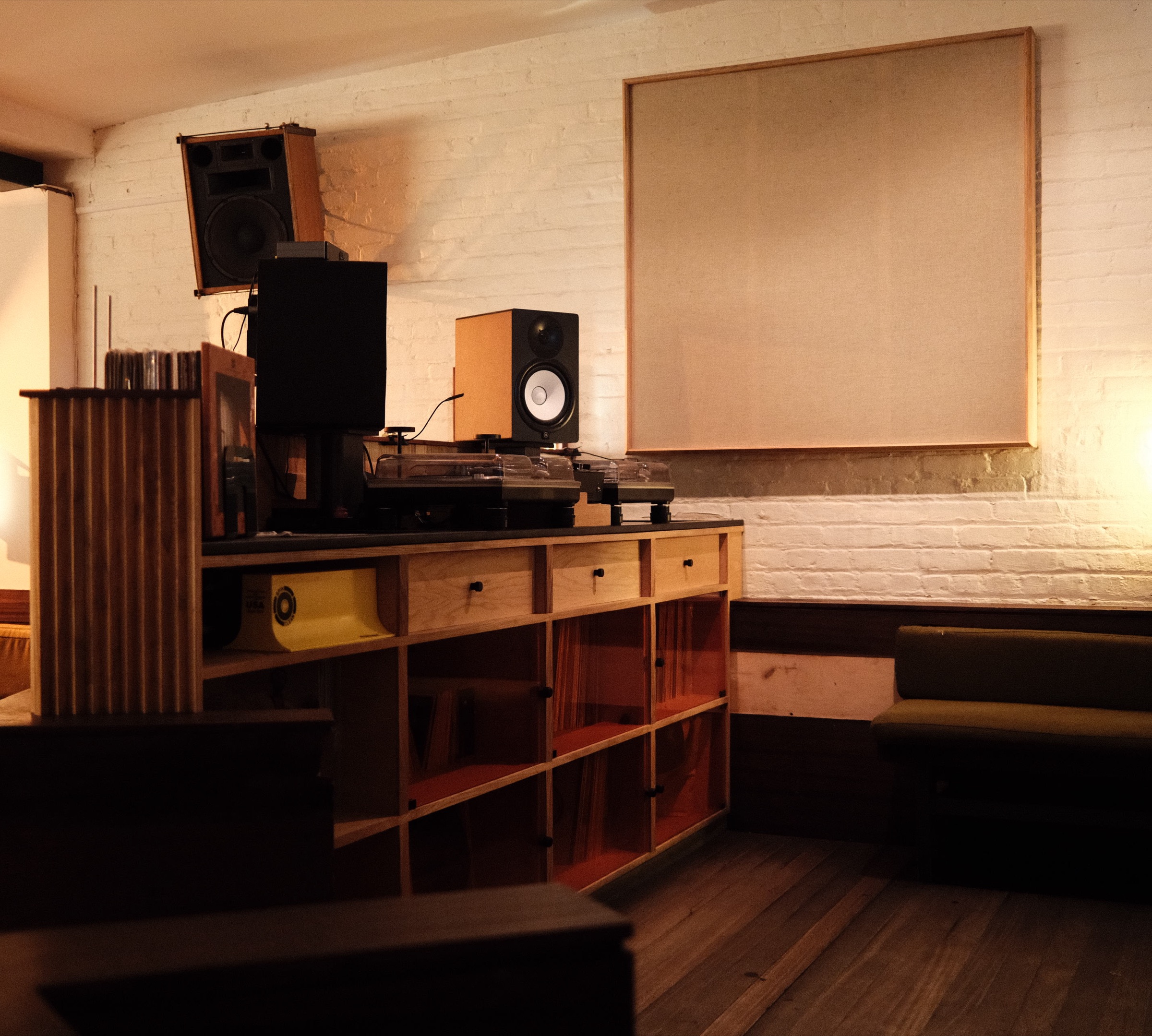
Against the whitewashed exposed brick hangs a layer of pleated softwood paneling that lightens the palette. The low tops on the main floor give way to a lounge area with larger seating and a DJ booth. Here, the large 1970s Klipsch La Scalas (one of three pairs of speakers in the bar) are displayed on their own shelves, underlit like floor model cars. Nate purchased them from a Canadian estate sale on eBay in 2018; he drove across “Our Friend Jean” is Brooklyn’s answer. After traveling to a number of historically black colleges, the West Village. The apartment was stocked with high fidelity gear and an expansive analogue collection. Jazz and hifi soon became obsessions. He enrolled in an ethnomusicology course taught by Evan Rapport, where he also became infatuated with world genres, from Mali desert blues to Turkish psych rock.
Then, in 2017, a cork-padded barroom in Tokyo called Jazz Blues Soul, made Nate fall in love with kissa. JBS is a small bar even by kissa standards, with only a few tables and chairs and one employee, a bartender who plays his own record collec tion for an entire night. His massive catalogue wraps around the room and reaches from the floor to the ceiling; you might feel like you’ve stumbled into a section of the Library of Babel.
A melange of old school hip-hop, funk, and jazz pours from hulking speakers in pristine waves. The cramped quarters lend themselves to the listening: if you’ve never been to a kissa, you’ll feel closer to sound than you ever have in your life. “It felt like going back in time,” Nate says. “Something flipped in my brain.”
He left Japan feeling that he had to bring the jazu-kissa back home. the border in a U-Haul to pick them up.
Their sound is a perfect match for the intimate mood. They imbue the records with a warm, rounded, low-end sound.
You half-expect someone to pull on a cigar at the end of the bar, but the eclec tic record selection unmistakably places you in 2026.
Nate’s love for vinyl began in 2011 while studying at the New School and living in a family friend’s apartment in Nate imagined a bar where one to two people held down the shop with a turntable behind the bar and records lining the walls. The front area would serve as a separate, quieter week end bar for people who wanted a tamer experience. Customers would leave having expanded their music taste, perhaps expe riencing Afrofunk or Yugoslavian prog for the first time, after asking the DJ about the music. (Nate decries Shazam-ing in these settings, seeing music discovery as a necessarily social experience)
In 2021, Nate took over as the music and DJ curator at Bar Meridian in Prospect Heights. As the owner took a step back, Nate’s responsibilities increased. He learned not just how to run a bar — managing inventory, training staff, keeping the books — he learned how to run a music-driven bar — keeping a music program interesting, placing speakers intentionally, vetting DJs. It didn’t take long for Nate to turn to bar manager and longtime coworker, Nik Vagenas, 38, and say “We can do this on our own.” The two set out to create a different kind of nightlife experience, with Nate’s eBay-bought Klipsch speakers at the center. His kissa dream was poised to become a reality.
But when the pair first saw the space on 61 Withers Street in 2023, Nate realized that the environment he’d admired at JBS in Tokyo was not going to work in New York. When New Yorkers drink they like to dance and meet new people, not ponder atonal time signatures. Japanese listening bars are a refuge for quiet and isolation; they aren’t social environments. Any attempt to recreate a true kissa environment here would require rules, and New Yorkers don’t like being told what to do. “If you were to put a sign in a New York bar that said ‘No Talking,’ it just wouldn’t work,” Nate said.
The logistics presented an even bigger challenge. Having just a single bartender would have stranded customers on busy weekends. A record player behind the bar would get in the way of frantic bartenders catering to the impatient masses. Setting capacity limits was simply bad for business.
Looking back on the experience, Nate tells me, he feels naive for thinking a strictly Japanese model could make it in Brooklyn.
Now, Mr. Melo is most popular on the weekends, when the bar hires DJs for the Friday and Saturday night droves. The best nights, Nate says, are the ones where one person starts dancing and a spontaneous chain reaction occurs that converts the space into a dance floor.
Adapting his kissa ideal to the realities of Brooklyn night life was a “difficult pill to swallow,” Nate says. But he didn’t resist the changes. The business was successful; his custom ers were happy. While Mr. Melo is often grouped with other listening bars, Nate feels the term is inaccurate. “We’re a bar with a great sound system, a great cocktail list, and a great DJ program.”
Still, Nate never let go of his passion for deep listening.
When we spoke, Nate was in the process of revamping the sound system: he installed two new Klipsch Heresy speakers so that the sound could make it to previous “dead zones”, as well as a universal processor to more easily equalize each set of speakers.
He also plans to put up sound dampening panels to muffle chat ter and other mid-range frequencies. These changes will come in handy when the bar hosts listening sessions. These nights begin with the goal of contemplative listening to a full album, but, Nate tells me, the silence lasts about 45 seconds. Even if no longer a true kissaten, Mr. Melo still sees people gather to appre ciate music and expand their tastes. On Mondays and Tuesdays, you can sit at the bar and enjoy the Klipsch speakers. But you’ll be one of the few.
In the 1950s, Japan’s defeat in World War II could be felt in every corner of society. Allied bombings destroyed a quarter of the nation’s wealth, while shortages and inflation con tinued to stifle the economy. Major cities physically embodied this loss: buildings were reduced to rubble (if not ash) and 30% of the nation’s urban population was homeless. As millions of wounded soldiers demobilized and re-entered society, occupy ing American servicemen became a daily presence. Despite the climate of austerity and displacement, the urban poor developed an appetite for U.S. culture. The Japanese found refuge in the latest commodity: American jazz.
But music was hard to come by. At this time, one U.S. dollar was equal to 360 yen, and very few could afford the price of imported records. Jazz was seldom available outside American army bases. One of the few places left to find Western music was at the kissa bar, where wealthy and wily kissa masutaa competed with each other for the latest releases and at times drafted private shipment deals with US businesses directly. As new cultural norms took hold, young men who couldn’t afford records finally had a small, smoke-filled, dimly-lit room where they could listen.
Seventy years later, the problem has reversed. Music is ubiquitous. Anyone with a phone can summon more recorded music in seconds than a kissa masutaa could have amassed in a lifetime. This is partly why Japanese listening bars have become far less prominent than they were at their mid-century height. But to Western listeners overwhelmed by an endless supply of songs, playlists, and algorithmic recommendations, the remaining kissa can offer another scarce resource: attention.
To people like Jesse Johanning, a 34-year-old creative director in Bed-Stuy, the kissa might even give you a religious experience.
Jesse remembers visiting a crowded neighborhood of Tokyo, where he stumbled upon Meikyoku Kissa Lion, a 19th-century European church that serves coffee in pews and plays classical music from an altar. The music came from a 10-foot wide, cus tom-made high-fidelity setup. The café played a recording of Bach’s “Jesu Mein Freude” by the Trinity Baroque ensemble. He could hear the voices from the speakers echo three times in the room around him. When he went back to his hotel and listened to the same recording on headphones, he could only hear the voices echo once. The kissaten, Jesse said, made him feel like he was “immersed in some ancient cathedral.”
Jesse is one of many Brooklynites who care deeply about sound and the systems that reproduce it. He’s an audiophile. To this subculture of music obsessives, the magic of high-fidelity setups comes in recovering details ordinary listening conditions erase: the undertones of the instruments, the moments between the notes, the movements of the musicians’ bodies, every possi ble frequency down to fractions of percentages.
For Adam Lehman, a 33-year-old designer from Carroll Gardens, intentional listening offers more than an escape from the algorithm; it offers transcendence. “When you hear a system that resonates with you, it does just that — it vibrates you physically,” Adam told me. “You don’t always know why it resonates, but at the end of the day these systems are portals to better feeling.” He feels this experience has appeal beyond his subculture: “Great sound is universal.”
But to hear all those subtleties, frequencies, and undertones, you need a focused environment. In New York, audiophiles like Jesse and Adam can expect noise complaints the moment they fire up their systems. It’s little wonder so many have made it their mission to track down a third space for deep listening.
To the most hardcore contingent, however, what they find in Brooklyn falls woefully short. The sound is muddled by talk and laughs, the thoughtless scraping of chairs, the clink of glasses.
And if you want any hope of hearing the music, you better show up on a weekday. In Japan, listening isn’t optional; it’s enforced. Customers must adhere to hardline policies: when a server approaches, you have to point to your drink on the menu; phones aren’t allowed; talking must be limited to only the most necessary whispers. In comparison, the Brooklyn adaptations feel like cheap knockoffs.
Joe Constantino, a 41-year-old designer and creative director from Bed-Stuy, told me that people go to listening bars to “look and feel cool.” What’s important, he says, is presence. “It’s not music in the background while I’m doing something else. The thing I’m doing is listening. You want to hear every nuance and be as there as you can be.” One former New Yorker, who now owns a bar in Bangkok, remembered listening bar regulars as “cosplay cultural sophisticates that have no musical taste of their own.”
But other self-described audiophiles I spoke with question how much of the Japanese ritual needs to survive. They com plained about the constant babble, and some argued that bars too often spend lavishly on ostentatious equipment without giving the same care to speaker placement or the room itself.
But that didn’t stop them from writing down the name of an unfamiliar album or simply enjoying the vibes themselves.
Many enjoyed Kissa Kissa on a quiet weeknight and appreciated Eavesdrop’s intricate acoustic design. At Bed-Stuy’s recently re-opened Dynaco, Jesse is able to get past the chatter: “If you listen closely, you can hear the bass guitar separated from every thing else. The whole place is calibrated really nicely.”
Perhaps no one feels transported to an ancient cathedral.
But not everyone expects transcendence when they go out. An unusual percentage of the people I spoke with, from owners to casual patrons, likened listening bars to living rooms. (I asked Bernie Mehl, 41, an audio engineer in Bed-Stuy and founder of Bernie’s Audio in Greenpoint, if this was an industry term; he told me it wasn’t.) The casual bargoer is more interested in the vibes than the undertones of the record. They might be on a date, or grabbing drinks with friends, or perhaps were enticed by the “arthouse aesthetic” they found on their FYP . What lingers after a night out is typically the multi-sensory experience and an elevated atmosphere. The music simply pairs well with the craft cocktails and the occasional incense stick; it’s just another element of design.
But many audiophiles think that there is still value in a room designed for better listening, even if they stray from the original kissa. For Frank Lenz, 40, an audio engineer in Bushwick, the listening bar is to music heads what the sports bar is to sports junkies. “These hi-fi listening bars are for when you want to be around others that either identify as audiophiles or are curious enough about the lifestyle that they patronize the same space,” he says. “It helps me feel a connection to others.”
Dan Wissinger made it his mission to keep the listening bar alive in Brooklyn. To do so, he learned, he had to make com promises. Dan co-runs Eavesdrop, a cocktail bar in Greenpoint that opened in 2022, just half a mile from Mr. Melo. Like Nate, Dan set out to build a space around serious listening; he too ran into the realities of Brooklyn nightlife. But instead of accepting the crowds, Dan tried to domesticate them.
Dan first learned about listening bars from a series of Res ident Advisor YouTube videos in the mid-2010s. At the time he was DJ-ing under the name Dan Demerit. He was used to raucous audiences and was heckled whenever he put on a jazz record. But kissa presented another possibility, a place where an audience could gather to simply sit and listen. If you had met Dan at one of his shows at this time, he would have told you that New York was the perfect city to open such a place.
When the pandemic hit, Dan found himself out of a job. Con certs were cancelled. His band couldn’t find a studio to rehearse in. New Yorkers had more pressing problems than a DJ who imposed experimental jazz on the Saturday night dance floor.
With nowhere to publicly enjoy or play music, he decided to leverage his knowledge of kissa to create a new venue himself.
He went about raising money from friends and family and enlisted Danny Taylor from House Under Magic to build the bar’s interior. The result, Eavesdrop, is a marvel of form and function, making acoustic design aesthetically pleasing. Corklined walls and sound absorption panels in the ceiling drench the interior in shades of beige. A wall of tiny mirrors inlaid at dif ferent depths is both Instagrammable and part of the bar’s sonic architecture: they serve as a diffusion mechanism, preventing sound waves from gathering at a single point of resonance and producing an echo. A clap is quickly drowned out.
But as soon as the bar’s soft-opening in 2022, crowds descended. Familiar faces showed up as the doors opened and Dan’s personal record collection filled the room. As the night wore on, friends of friends began lining up outside. Eventually, the place was packed. No one could hear the music. But Dan refused to turn up the volume. “No one is going to appreciate what we built here if we just pack the room,” Dan says.
So Eavesdrop opted to limit the crowd. The bar adopted a no standing room policy and began taking reservations to ration its limited seats. Casual barflies are sometimes confused by the pol icy when they see open space. Friends of DJs can get frustrated when they’re turned away without a reservation. But the kind of spontaneous dancing Nate cherishes at Mr. Melo isn’t what Dan is after. He views Eavesdrop as a destination, perhaps a place to celebrate a milestone or to impress a date while enjoying bespoke audio. He even decided to raise drink prices. Maybe for the listening bar to survive in Brooklyn, it needs to be exclusive.
Due to Japan’s strict travel bans, Dan hadn’t actually visited Japan until Eavesdrop opened. In 2023, he planned an itinerary of 20 kissa in Tokyo and beyond. He discovered that, even for the Japanese, the actual definition of “listening bar” is slippery at best. Aoyama Tunnel in Tokyo is a small techno/ dance venue whose decor includes a coffee machine spraypainted gold. Shelter in Hachoji has separate spaces for deep listening and dancing. He doesn’t feel that the seeming incom patibility between American and Japanese social norms prevent “real” listening bars from working in New York; there isn’t a single way of doing a listening bar. Instead, it’s about centering the bar’s ethos and design around listening.
By the time you leave Kissa Kissa, the bar and high tops have all but emptied. The bartenders lean against the backbar and add to the chatter. You’ve listened to three records, you’ve had as many drinks. You try to sober up in the night air on Saint Marks Avenue. Your mind rivets on what you just expe rienced. What you did in Kissa Kissa wasn’t listening, per se; it was more like your stimulation chanced upon more stimula tion. You remember how impressive the record sounded, but the melody itself remains elusive. The anticipation has splintered from a communal experience to an individual one. It has stayed with you as you walk up your stoop. When you get in, you put on your noise-cancelling headphones and play the first record from the night. You congratulate yourself for finding a way out of the algorithm, but you still can’t fit the melody to what you experienced earlier.
The listening bar, if you listen to it, gives you a paradox that you desperately want to straighten out. This unresolved feeling gets deeper. It recurs whenever you experience novelty.
You need to see if there’s any truth to these rumored, Borgesian locales — bars that throw you back in time and cafés that split you from space. You decide to check on flights to Tokyo.
As you go to bed you realize that you’ve come face to face with potential in a rare moment. The world wants to solve all your problems all at once, as soon as they come up. But you’ve exposed yourself to friction. Enduring it, you get a sense of possibility. You just needed a vinyl record player and some beer.