The Music of Steel
Inside the grueling quest to win North America’s biggest steel pan competition.
Inside the brutal quest to win North America’s largest steel pan competition.
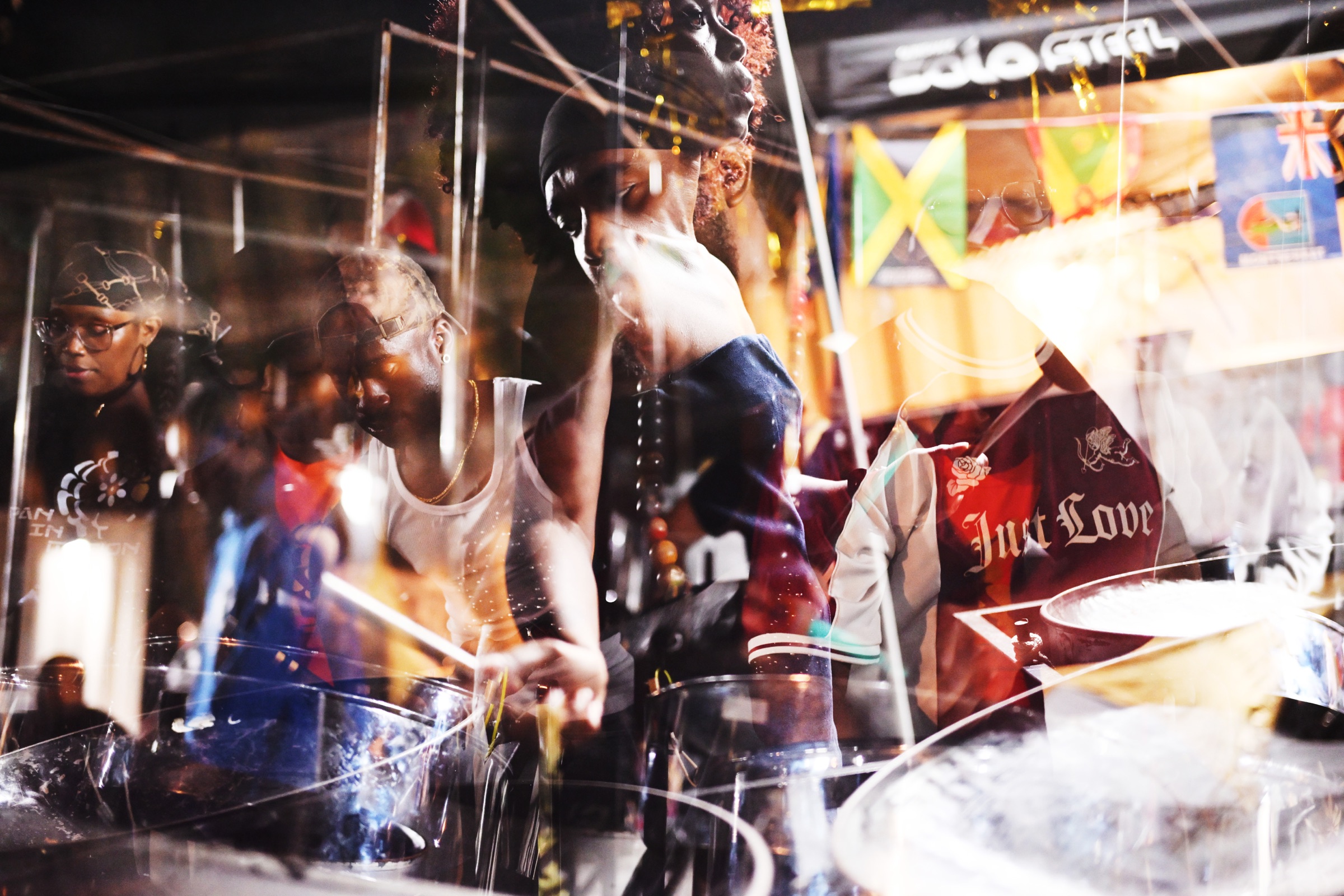
On a late August ty-two-TK and scruffy-bearded, paced through a posse of musicians in a parking lot, brows furrowed in intense con centration as he endured hundreds of decibels of grooving calypso. The calypso, which had a distinct brassy sound not unlike that of many metal kitchen bowls being dropped simul taneously (but more harmonious), emanated from fifty-odd upside-down oil drums, which players were hitting with mal lets. Suddenly, the machine-gun-esque sound of a cowbell pierced through the music, and the players trickled to a stop.
“Do it again!” said the drill sergeant, a man dressed in a Yankees cap and a floral-print buttondown, in a thick Carib bean accent.
They did it again, for about the two-hundredth time.
“ Are you tired?” the drill sergeant asked.
“No, ” the orchestra players yelled.
But those kinds of decibel levels wouldn’t pass muster with a drill sergeant.
“I said, are you tired?” “No!” “Well, then do it again!”
Judging from Kendall’s expression, Pan In Motion, his steel pan orchestra, would be doing it quite a few times more throughout the ten days before the Brooklyn Panorama. The largest steel pan competition in the US, second only to a competition in Trinidad and T obago, the native land of the evening, Dr. Kendall Williams, for steel pan, the Panorama is steel pan’s Superbowl. T en or so com peting “steel orchestras, ” each comprising around a hundred members, prepare a ten-minute arrangement of a soca song of the day and play it to a crowd of thousands. Judges expressly imported from Trinidad and T obago appraise the perfor mance and determine the winners. In fact, the term “winners” is somewhat misleading: despite the fact that all bands are ranked, there is only one place anyone cares about.
Actually, to be precise, two places. The play ers I talked to relished knowing not only which band placed first, but last as well, which reveals something of the ruthless nature of Panorama.
Outsiders tend to casually refer to the pan orchestras as “bands. ” In this context, that term is inappropriate almost to a pejorative extent, since it so thoroughly fails to cap ture a steel orchestra’s size and gravity. Each orchestra numbers more than a hundred players, many of whom fly in from Trini dad and other countries the week before the tournament. (That figure does not include the families and other subsidiary per nel who sit on the panyard’s benches every night, providing nourishment and boosting morale.) These orchestras are no fly-by-night college-basement operations, but full-on bureaucracies—which means, for instance, that they have positions like “team captain, ” “community outreach liaison, ” and “media correspondent. ” The bands are officialized partly for legal and PR reasons, but mostly because the competition results they desire can only be achieved by dint of martial discipline.
Every night in August, Pan in Motion had practice from 6 p.m. until 10 p.m. Some other orchestras had started practicing as early as June, so not a moment could be squandered.
T o an outsider, spending hundreds of hours to win a paltry sum of cash— or, more likely, no cash at all—can seem deeply irrational, as irrational as sports or love. But as anyone who’s watched the NBA playoffs or weathered a multi-yearlong toxic situationship knows, sometimes these things don’t seem so irrational. The TK-dollar cash prize is mostly incidental; what the bands are really competing for sonis the chance to assert domination over their rivals, which goes some small way in settling rivalries that extend back to Panorama’s beginnings in the 70s. At that time, rivalries had been unsports manlike; sabotage and pan detuning were commonplace, and players from different orchestras were forbidden to consort with each other. Now, the rivalries are mostly limited to accusing an orchestra of brib ery or foul play. Still, their effect on the orchestras, whose members often enter a state of mouth-foaming frenzy upon hearing their rivals’ names uttered, is no less intense.
Yet for all their high hopes, most orchestras lose. Although this is not particularly astonishing, it strikes one as unfortunate. Each of the competition arrangements is performed only once— reusing an arrangement is considered declasse—and due to years of Cold-Warish arms racing between the arrangers of the bands, these arrangements are highly complex. If each band practices, say, for a month, four hours a day, and practices only the one arrangement they will per form, that arrangement would take a total of around 120 hours to rehearse—poten tially all for nothing.
Kendall, however, did not appear to worry much about that horrifying con tingency. He was a man who dealt not in hopes, but in certainties.
“I’m done losing. This year, we’re going to win. I’m sure of it,” he said.
Unlike the other orchestras, Pan in Motion was hoping not to assert domi nation over a rival, but simply to acquire one. Founded in 2022, Pan in Motion was an upstart in the Brooklyn pan scene, and the older orchestras had not yet deigned them with their enmities.
They’d only be worthy of such attention if they won a Panorama, at which point they would inevitably be accused of foul play. Although Pan in Motion hadn’t yet won, they were nonetheless on an upward trajectory, with a TK-place result the pre vious year. This was due in no small part to the efforts of Kendall, the founder, director, arranger, and general torch bearer of the orchestra. Loved or feared in the pan world (depending on whether you were in his band or not), Kendall was a formidable weapon. He was a respected player and had competed in other win ning Panorama bands, but his arme secrete was arranging. The arrangement of an orchestra’s tune is one of the most important criteria in Panorama, and has been the downfall of many a band: no matter how much a band practices a shit arrangement, it will always sound like shit. Given the difficulty of arranging, it is one thing to win a Panorama as a player, but another matter entirely to win one as an arranger. If Pan in Motion won, they— and most of all, Kendall—would receive, for the first time in their history, the two most desirable commodities in the steel pan world: glory and hatred.
Oscar Wilde said, the world is about sex, except sex, which “Everything in is about power.” For the Pan in Motion players, everything in the world was about steel pan, except steel pan, which was about winning. In this respect, steel pan is much like a sport. And indeed, Pan in Motion employs the techniques used by the most successful sports teams. There is the merciless drillmaster, who demands exacting conformity. There is the players’ shit-talking of other bands, usually pref aced by a pro forma disclaimer that does not ameliorate the shit-talking whatso ever, such as “They’re good people TK, but…” There is the team captain—in this case, Mark Garceran—who acts as the team’s firebrand, a master of that peculiar dialect of motivationalese found in pregame football interviews.
But just as a team is nothing with out a coach, a band is nothing without an arranger. In ensuring that their band achieves the desired outcome in Pan orama, the arranger must master not only music theory, but also game theory.
This year Kendall had decided to arrange what was currently the most popular song in Trinidad, a high-energy soca number called “Cyah Behave” (“Can’t Behave” in a Trinidad accent), for reasons as political as they were musical. Choosing the num ber-one Trinidadian Billboard song is sort of like hitting on a 19 in blackjack. Many orchestras will play an arrangement of it, and some version of it usually takes home first place. But since it is comparatively easy to assess versions of the same song, the non-winners usually end up doing poorly indeed. Those that opt for this route tend to have a high-roller mindset.
“There are politics involved in the competition,” Kendall said. “Where I am—given my rank—I need to do some thing popular. I’m sure other arrangers will do this song too, but I’m gonna do it the best. I want to beat them all.”
Since the arranger is essential to a band’s success, cares must be taken to shield them from the world’s chaos. Like a football quarterback retreating to his hyperbaric oxygen chamber, Kendall spent most of the time at the panyard sitting in his car so that he could edit his A drummer at his set. Photo by Wali Khan arrangement without distractions, while his wife kept the crowd at bay. “Don’t disturb Kendall. Y’all know Kendall,” she would tell the throng of courtiers surrounding his car. But those courtiers were getting quite disturbed themselves, because it was a week before Panorama and Kendall still hadn’t finished writing the last half of the arrangement.
However, when I talked to him after practice, he didn’t seem too concerned.
“I’ve done fifty Panoramas, and it’s always like this,” he said.
Born into a pan-playing family, Ken dall started playing pan at four years old.
Without any siblings or technology to occupy his time, he’d loiter around the panyard most of the day. He went to a Florida State university and somehow managed to major in steel pan, despite there being no official pan program. He then did a master’s degree at NYU, again concentrating in steel pan, and went on to receive a doctorate degree from Prince ton, where he studied steel pan yet again, making him close to the most accredited pannist in the world. Yet somehow the degrees hadn’t gone to his head, and he was just a regular, if aggressively compet itive, guy. In 2021TK, he founded Pan in Motion. Several people referred to the band as his “child.”
Kendall wasn’t the only one whose schedule revolved around the band. For Mark Garceran, his second-in-command and team captain, pan was nothing less than “life.” Mark had played pan about as professionally as one can in the pan scene, performing in Panorama tournaments around the world, including ones in Lon don, Trinidad, and India. Running only on “Celsius and a dream,” Mark arrived two hours before practice to set up the pans, as he did every practice. He wore Prada sunglasses, a silver necklace with a Trinidad-shaped pendant, a shirt that said “Long Live Soca,” and Air Jordans, the latter a nod to his love of basketball.
In general, Mark explained to me, he was the first one to arrive to practice and the last one to leave. As I learned, practice is usually around four hours long, which meant he was spending around six hours in the panyard every day—all on top of his nine-to-five as a paralegal.
The term “band” fails to capture the size and gravity of this hundred-piece organization that it was Mark’s job to corral. This was no fly-by-night col lege-basement operation, but a full-on bureaucracy—which meant, for instance, that it had positions like “media corre spondent.” This role was fulfilled by Hanaa, a snappily-dressed woman in her 20s who was part-Trinidadian, like many of the players. Hanaa was a seventh-grade science teacher by day, and by night man aged the social media and community outreach programs of Pan in Motion.
She also managed the financial side of Pan in Motion—a daunting task. Every year it costs a band around fifty to sixty thousand dollars to play in Panorama. It was Hanaa’s job to apply for grants, which were the main income source of Pan in Motion. These grants would cover the rent for the panyard; the surprisingly high pan-tuning fees, which ran into tens of thousands of dollars; and TK. The grants and sponsorships were often municipal, and every year harder to come by, since grant money hadn’t kept up with the pro liferation of organizations applying to put on their cultural events.
“Now there are a lot more cultures applying for these grants, and sponsor ship has to divide them up,” she said.
“There aren’t enough slices of the pie to go around.”
Those unfamiliar with Pan in Motion’s finances would never know it, but every year, Pan in Motion depended on a mir acle to fund its season. This year, as had happened every year since 2022, Pan in Motion’s founding year, one had occurred again—but there was no guarantee that this lucky streak would continue.
A few days later, I sat in another Brooklyn panyard for four hours straight, watching a short Trinidadian man hit convexities in a concave metal bowl with a mallet. He wore a grey tanktop, and For the Pan in Motion players, everything in the world was about steel pan, except steel pan, which was about winning. was sweating profusely on account of the weather, which was nothing short of Trinidadian. The routine was the same for each note: bang the convexity a few times with a rubber mallet in his left hand, starting slow and increasing in speed; come at it with a metal hammer in his right hand; look at a strobe-lit device with a bunch of red flashing lines; bang some more. Repeat several hundred times.
I’d realized that for all the players’ expertise, few people could explain the mechanics or history of the instrument itself. So a few days later, in the panyard Arial Cook; Felix Lance; Stu Cheryl. Photos by Wali Khan and Lukas Flippo. of the Brooklyn-based Pan Evolution Steel Orchestra, I watched a pan tuner ply his craft. In fact, this man was no ordinary pan tuner, but Jason Holden, tuner of the winning Panorama band for the past three years, which made him per haps the best tuner in the world. (Since the field of pan is so niche to begin with, meeting a world’s-best is not actually that uncommon.) Jason had flown in from Trinidad to tune the pans of sev eral orchestras before the competition.
In such a neck-and-neck competition, intonation can play a decisive role, so orchestras don’t mess around with their tuning. As a general rule, the tuner must tune the pans as close to the competition date as possible (to minimize detuning), and they must be from Trinidad. This meant that Jason had to tune the pans of three orchestras, one of which was Pan in Motion, in the two or so days before U the competition, which equated to sev eral thousand notes in desperate need of tuning. Consequently he could only talk to me while simultaneously banging the pan with a hammer, a fact which, along with his thick Trinidadian accent, heavily limited our conversation.
Still, amidst the din, I was able to glean a few crucial facts. For one, the steel pan bears no relation to the tool used to fry eggs—a common confusion in the non-pan world—and in fact is far more complex than that rudimentary item of kitchenware. Although the steel pan is made of simple materials—an upside-down oil drum with a concave head—tuning it is extremely difficult, due to the nature and shape of the material.
The main issue is that since all the notes occupy the same malleable piece of metal, tuning one note often leads to all the others going out of tune, a phenomenon which often caused Jason to curse out loud. Other difficulties include “blending” the sound of the band so that all the pans not only have the same tuning but also the same tone, and not going batshit insane from the long hours and repetition of the same ditty.
The instrument hadn’t always been so complex. The steel pan began as an upside-down oil drum with no modifications, which musicians used to accompany dancing at Carnival, Trin idad’s largest festival. At the time, the drums played only one note, or rather a loud noise—calling it a note was a stretch.
The eventual introduction of more notes resulted from a moment of Darwinian serendipity.
“They beat oil drum with sticks, and the drum head sink. Every time it sink, it get different sound,” Jason said. “Then it get two note or three note.”
After that, it wasn’t long until players created the first concave steel pan featur ing all twelve notes of the chromatic scale, setting the stage for modern pan playing.
The simple oil drum had diversified into a variety of pans, with such names as Tenor, Guitar, Bass, Second, and Cello. The orchestral undertones were no coinci dence: the players were trying to build an ensemble with the power of an orchestra.
And there is no better word to describe a steel pan band than orchestral, with its deep basses and high tenors that, when played together, create an enormous sound. One of the Pan in Motion players claimed he’d never heard a recording that did the steel-orchestra sound justice. To hear it in its full splendor, one had to go to a panyard.
Until not too long one couldn’t just waltz into a Brooklyn panyard. The earlier iterations of pan orchestras, both in Brooklyn and Trini dad, were much like gangs. With names like the Desperadoes and the Invaders, borrowed from popular Western films of the time, they were all male, the bad boys of the neighborhood, and they nursed intense rivalries with other panyards.
Consequently, outsiders were viewed with suspicion, since they could tamper with the pans.
As pan became more institutionalized, though—in TKyear Trinidad and Tobago made the steel pan its official instrument, and Panorama was beginning to receive international attention—the pan bands began to lose their countercultural streak, and the surrounding communities flowed in. These days it was not uncommon for kids to seek refuge in the panyards from the rough-and-tumble streets, where they could easily take a wayward turn.
One parent described the panyard as a “babysitting platform” for their child. It wouldn’t take these children long to start messing around with the mallets, and a few years later, they too would be perpet uating the legacy of pan culture.
Mark Garceran was acutely aware of this fact, having been one of these chil dren himself. “Steel pan saved me from being out and about, hanging with the Wwrong crowd,” he said. “Now my goal is to do what it takes not only to win, but to inspire people to do better with their life.
A lot of the speeches I’ve given this sum mer have been, like, ‘I see your potential.
I want you to see your potential.’ I want them to love this as much as I love it.”
Now Mark, along with Kendall, taught steel pan in schools, in hopes of luring children to the panyard. Schools were part of the history of steel pan: thirty years ago, New York City’s Carib bean-neighborhood public schools had officially made steel pan an accredited program in their curriculum. Mark had discovered steel pan at school himself, after trying a variety of instruments that didn’t suit him, including cello, trombone, ago, however, and piano. Judging by the demographics of the band, his efforts had been working: around a third of the orchestra’s members were school-age kids. While the kids did not do wonders for orderliness—they tended to play their instrument while the drillmaster was talking, which was a long standing vexation of the drillmaster’s and the cause of several glorious crashouts on his part—their school-recess vibes livened up the band. Regular hooting and shriek ing emanated from the bass section (the farthest section from the drillmaster, where most of the kids resided), and sev eral of the preteens would weave through the orchestra at high speeds during run throughs, playing some form of tag that usually ended in a collision with a pan, or even worse, the drillmaster.
The steel pan craze had infected not only students but faculty as well: mid dle school teachers, principals, and at least one professor was part of the band.
Michelle, a tenor player and elementary school principal. explained that the steel pan classes in her school were not only important for the students of Caribbean heritage, who were learning about their culture, but for the pan bands teaching those classes. The pan bands needed money, and schools were a far more reliable source of income than one-shot windfall grants.
“At one point, I thought pan was going to die. Schools are a way to keep it going. It’s all about funding. It’s all about money,” she said.
But even school income was no longer guaranteed. The public school system was looking to cut costs, and higher-ups had begun to question Michelle’s steel pan program.
“With New York City public schools, the arts go first.”
When I walked ou yard, I was met with the sight of a blocklong Pepsi packing warehouse. Behind it were towers of boxcar containers. To the left was the front of an auto-works shop, which was either a defunct busi ness or a money-laundering operation; it appeared to have not been used in years.
The panyard was located in its abandoned parking lot, around the back. Abandoned cars with unrepairable dents littered the front. The only sign of life in the area was a teenager sitting behind one of the cars, smoking a joint.
Brooklyn’s panyards used to be located squarely amidst the hustle and bustle of historically Caribbean neighborhoods like Prospect Heights. But in recent years, those neighborhoods, like many other immigrant neighborhoods, have succumbed to an all-too-familiar plague: yuppies. Rent in Prospect Heights was described to me as “unmakeable.” Now, most panyards have had to relocate to the boonies of Brooklyn—industrial neigh t of Jason’s pan borhoods like Far Rockaway or Canarsie Parkway. Pan in Motion was one of the only steel pan bands that had managed to stay in its historical environment. Their lot rent was around five thousand dollars per month, an expense which came on top of tuning, pan repair, and city permit fees.
Rent wasn’t the only issue these yup pies have brought to the neighborhood.
This year, Pan in Motion had to deal not only with the astronomical rent, but with something far more serious: noise com plaints. If the complainers succeeded in their efforts, Pan in Motion would have to withdraw from the tournament.
After arriving at Pan in Motion’s pan yard that first day, I soon realized I’d come at a moment of crisis. The moment I set “We fought to keep this panyard.
I don’t know what other bands are going through, but we fought—you understand me?— fought to keep this panyard.” foot in the yard, Hannah, the media coor dinator, sprang into action. She pulled me to the side and began to walk me through the legal nuances of the case, every now and then consulting a thick dossier of legal arguments she had prepared spe cifically for the media. Mark, whose jur isprudential knowhow had rendered him Pan in Motion’s de facto legal counsel, got a word in every now and then as well.
They pointed out a highrise building across the street, emphasizing the build ing’s poshness. Inside that building lived a neighborhood gadfly named Dara S., who I was surprised to learn was the only com plainant. However, Dara was not to be underestimated. She had been calling the cops on Pan in Motion nightly, sometimes as much as three times in an evening.
The cops couldn’t actually do anything, since Pan in Motion had acquired the proper permitting and weren’t playing past quiet hours. Nonetheless, they had to show up every time a noise complaint was reported, due to a law that requires NYPD to investigate a noise complaint every time it is reported. Every time they came, the band had to stop practice for a while to deal with the paperwork. Five or six 311 calls in a night, and practice would be shot through.
“A lot of bands will give up at this point. They don’t want to fight. But the problem is, our captain likes to fight,”
Mark said, referring to himself. “We were here forever. People don’t know the his tory of steel pan in these neighborhoods.
Besides, if you don’t understand steel pan playing, it’s just noise. That’s the problem.
How can we make them understand this culture?”
There was less than day, and tensions were high after practice.
Between Kendall’s unfinished arrange ment and the noise complaints, there was more than enough to put nerves on edge. Whispers flew around—would Pan in Motion be shut down entirely? Would they be able to find another space within a week? The rat-a-tat of a metal stick on a pan sounded through the parking lot, and everyone fell quiet. It was Mark. He announced they’d be having a “pow-wow.”
Everyone assembled in a tight cir cle, some kneeling and others standing over them to get closer. After a moment of expectant silence, Mark stepped into the middle. He wore a T-shirt that said “Long Live Soca.” He looked around, the full 360º, and cleared his throat.
“This is a passionate time for me, and I really want you to understand this,” he said.
The hundred-odd pan players were completely silent.
“We fought to keep this panyard. I don’t know what other bands are going a week till the big Crowds gather to see Pan in Mortion compete at Panorma. Photo by Thomas Cook. through, but we fought—you understand me?—fought to keep this panyard. Yester day, that’s why I was willing to practice through a hurricane. I didn’t even know a tornado was going on,” he said, refer ring to a thunderstorm so severe that it spawned not just one but two tornadoes in New York City. “Why? Because we almost lost this. Just like that.”
He paused to let the audience ponder that hypothetical.
“Maybe other bands didn’t have to fight. Maybe they haven’t even started practice. But you can see how much we fought to be here tonight.”
Like a preacher reaching the climax of a congregation, Mark began to hit his stride. The audience cheered after every line.
“We are practicing every single night until Panorama,” he said, emphasizing every word. “Repeat after me. Tuesday.
Wednesday. Thursday. Friday. Saturday.
Sunday.” Everyone screamed it back at him, with the synchronicity of a well-drilled ensemble.
“We are going to stay here at 998 Union!” he screamed. The crowd screamed back.
“We ain’t done yet. If there’s anything I want you to take away from tonight, it’s those four words: We ain’t done yet.
We got glory to chase. I don’t just say that because it sounds cute. I don’t just say that because it sounds cute. I don’t say that because I’m trying to motivate you. In my eyes, I see glory. Let’s hope the judges give us enough of a score so that we can catch our dream. Ain’t nobody takin’ that from us.”
The crowd clustered closer, screaming affirmations. They began chanting “Pan in Motion,” faster, faster, until the words broke down into a guttural scream. There was hope yet again.
Ultimately, Dara did not in quieting Pan in Motion. In fact, the blast of soca that greeted me as I walked into the panyard on the day of the tour nament was even louder than normal.
Pan in Motion had imported a battery of percussion players expressly from Trinidad, making the band close to 100 people strong. Their runthrough seemed pretty good to me, but afterwards every one, particularly the percussion players, seemed a bit frazzled. Kendall’s Muse had finally come through last night, and he’d added some substantial sections to the arrangement, including a minute-long introduction and a new ending. Would a few more runthroughs be sufficient to see them through?
According to Alexis, a bass pan player wearing a shirt that said “You Don’t Just HEAR the Bass Section—You FEEL the Bass Section!” it would.
“The air is ready,” she said.
Kendall was not so sure. “Today’s not succeed the day to be upset,” he said, in a tone that contradicted that statement.
I left them to their preparations and made my way to the venue, which was in a large grass field behind the Brooklyn The Philadelphia Pan Stars perform their number. Photo by Thomas Cook.
Museum, only a few blocks away. This took far longer than expected: two hours before the tournament, the festivities were already in full swing. The aroma of various fried foods suffused the air; stands selling tropical fruits, Trinidadian doubles, and shark lined the sidewalks; partygoers dressed either very elaborately or very sparsely had overtaken the streets, dancing at mosh-level density to the music of pan orchestras, who were running their arrangements in the midst of the crowds.
A block away from the station, the cops had erected a blockade and were trying to turn people without tickets away. Some of the unticketed argued back, already too drunk to realize they had failed to pur chase a ticket. Eventually I arrived at the main venue, where I plunged into a sev eral-thousand-person soca-fueled rave.
Almost everyone wore different shades of red, black, and white, the colors of Trinidad and Tobago’s flag. Then the DJ started playing Cyah Behave, and a pri Kendall conducted, firing his arm at the different sections of the orchestra like a sorcerer casting magic missiles. mal roar arose from the multitudes. The crowd moshed away with renewed fervor; people hugged each other; some were on the verge of tears. Then, just as abruptly, the music stopped—it was played so that the crowd had a reference for the arrange ments, in the unlikely event that someone there didn’t know the song—and Pan in Motion took the stage.
Cued by two ceremonial gong hits, they bowed with military precision. Then, fol lowing the tattoo of the drillmaster, they were off at a faster clip than ever before.
Kendall conducted, firing his arm at the different sections of the orchestra like a sorcerer casting magic missiles. The Trin idiadian percussionists were going at it in the back, and the soca rhythm began to work its mysterious ways on the crowd, setting feet tapping, hips gyrating, and Trinidadian flags swaying back and forth.
The band was also dancing, especially Mark, who was jumping up and down as if riding a pogo stick, a motion which somehow didn’t seem to affect his accu racy. Off his and all the front row’s pans hung noise complaint intake forms, on which someone had quoted various lines from the complaints in Sharpie: “Why So Loud?” “They Don’t Care,” “I Can’t Sleep.”
No resident of 1000 Union Avenue could stop them now. Like a Formula 1 acceler ating into the last lap’s straightaway, they crescendoed, then modulated up a half step. A big cheer went up from the crowd.
The band was soaring. The crowd went more and more apeshit, jostling together like a dense arena of bumper cars. Then the last chorus of the song, the sudden quiet, the last big build, the coalescing into rhythmic unison, a few last hits, and it was over.
I stayed for a few other performances, all featuring similarly complex arrange ments of Cyah Behave. Then, since results wouldn’t be released until 3 a.m., I returned to the panyard. When I arrived, they were moving the pans into a boxcar, where they’d be stored until next year. I’d never seen anyone move pans so gamesomely. A little girl, imbued with the panyard’s energy, ran up to me and screamed, “We did it! We did it!” Ken dall was so energized he couldn’t talk to me for more than a few seconds. He said it had been “a long season, lots of emotions,” and then went to move a pan.
Mark seemed equally excited at first, but his football coach instincts soon kicked in and he suddenly became a lot more philosophical than he’d been before the performance.
“If you’re only here to win, then you’ve lost,” he said.
In fact, as I would learn the next day, they did win. Although the judges ranked them eighth, the crowd ranked them first.
But a sadness also permeated the panyard. You could see it in the faces of people as they hugged for a few seconds longer than usual; in the way Mark fistbumped Kendall, and, at a loss for words, said “Mission accomplished. Now we gotta get out of this school.” Summer had ended at last, and there were jobs to do, homework to complete. Only the veterans of Panorama knew of the melancholy that would follow the tournament regardless of the results, how the same kids who’d complained about the long hours of prac tice would soon discover the deathless joke of sending the “When’s practice?” message in the band’s group chat. The rest would have to wait until it was over.